

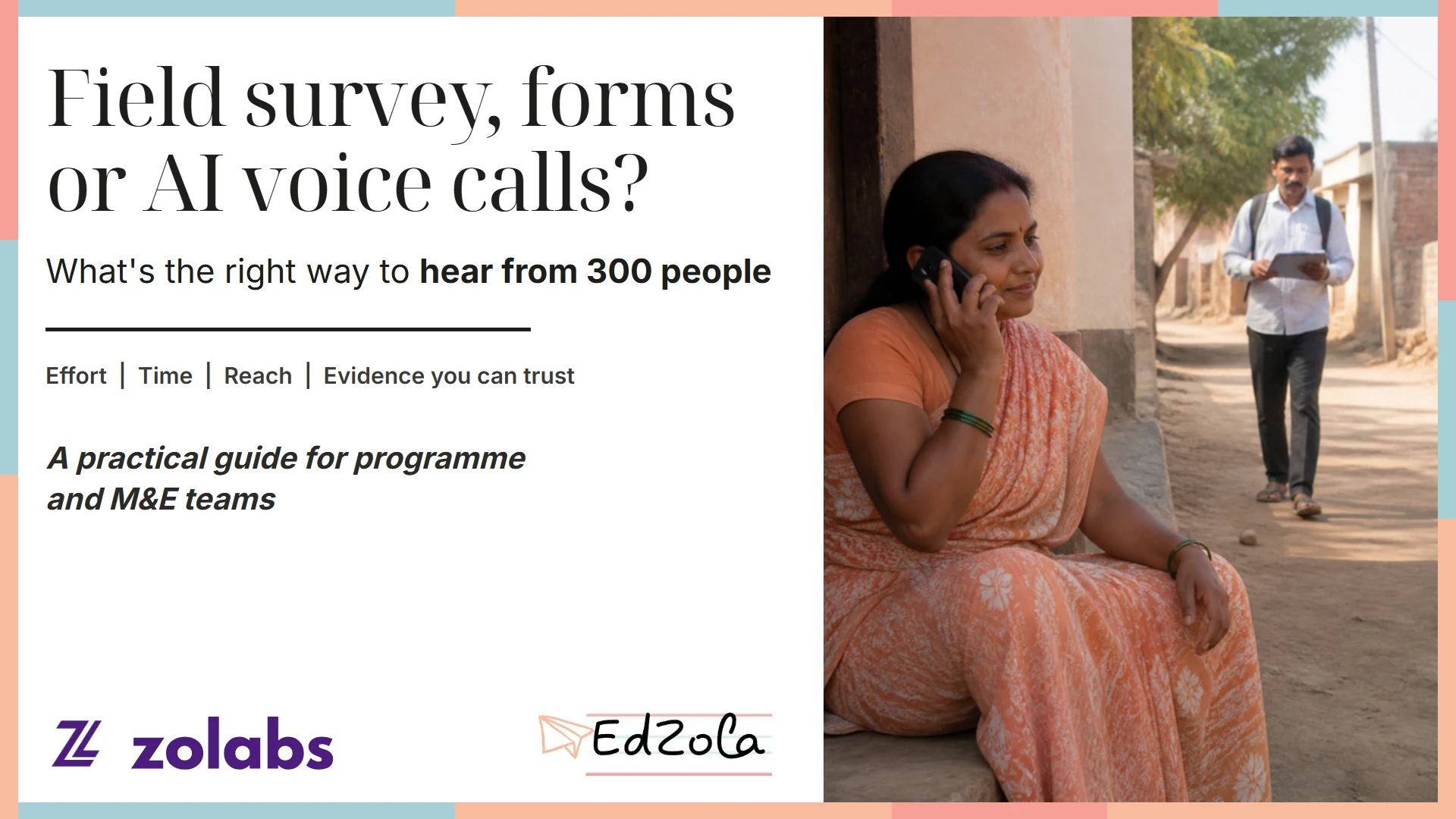
Your programme team needs to hear from 300 people.
You want to understand what changed in their lives, what challenges they still face, and what your programme could do better.
But before you begin, there are some difficult questions. Should someone visit each person, or should you send a form? How long will it take to reach everyone? What happens after you have collected all those responses? And most importantly, how soon can those responses become useful decisions?
Field surveys, paper or online forms, and AI voice call surveys each have their strengths. Let's look at what actually goes into a 300-person study, and how to choose the right approach for yours.
Why listening to 300 people takes more than collecting 300 responses
When we plan a study, we tend to picture the data collection. But that is only one part of the work.
Before the first response comes in, someone has to write the questions, translate them into each language your participants speak, and test them to make sure they make sense. Surveyors need to be trained, or forms need to be printed and shared. Participants need to be reached.
After the last response, the real work often begins. Paper forms have to be typed in. Recorded interviews have to be written down and translated. Someone has to read every open answer, group what people said into themes, count the closed answers, compare groups, find the quotes that show what people meant, and turn it all into a report your leadership or funder will read.
In many studies, these "after" steps take longer than the data collection itself. That is why a survey can finish in the field in a few weeks and still not have a report months later.
Three ways to run the same study
Imagine the same study run three ways: 300 participants, a mix of closed questions and open questions about their experience, in two or three languages, ending in a report your team can act on.
| Field survey | Paper or online forms | AI voice call survey (Zolabs) | |
|---|---|---|---|
| How people take part | Face-to-face with a surveyor | Fill in a form themselves | Answer an ordinary phone call |
| Travel needed | Yes | Paper: for distribution. Online: no | No |
| Reading and writing needed | No | Yes | No |
| Follow-up questions | Yes, if the surveyor is skilled | No | Yes, built into the conversation |
| Multiple languages | Needs surveyors for each language | Needs a translated form, and readers of that script | Built in: 10 Indian languages and English |
| Depth of open answers | Rich, if well probed | Often short or left blank | Spoken in the participant's own words |
| Analysis | Done by your team | Done by your team | Built in, reviewed by your team |
| Best suited for | Deep, sensitive conversations, or people without phones | Short, simple surveys with literate participants | Large, multilingual studies you want to repeat |
Field surveys are the most familiar approach. A surveyor sits with each participant, builds trust and notices things a form can't capture. The trade-off is travel, scheduling, and the size of team you need to reach everyone. Answers recorded on paper or tablets still need to be cleaned, and open answers still need to be read and analysed by hand.
Paper or online forms are quick to share and easy to set up. They work well for short, closed questions. But they depend on people being able to read and write comfortably in the form's language. Open questions often come back as a few words, or not at all, and there is no one to ask "can you tell me more?" Paper forms also have to be typed in before anyone can analyse them.
AI voice call surveys with Zolabs reach people on an ordinary phone, with nothing to download and nothing to read. The AI interviewer asks your questions in the language the participant chooses, listens, and asks follow-up questions, so you get the depth of a conversation at the scale of a survey. Many calls can happen at the same time. And because the analysis is built in, the work after the calls doesn't pile up.
Where the time and effort really go
Whichever approach you choose, the same steps come up. Here is where teams most often lose time.
Getting the questions right. Good questions take a few rounds of testing, in every language. A confusing question asked 300 times gives you 300 confusing answers. This step is worth the time with any method.
Reaching people. People are busy, phones are switched off, numbers change, and forms get ignored. The hardest people to reach are often the ones you most need to hear from, such as women, older participants or people with low literacy. Forms make this harder, because they quietly leave out anyone who can't read them. Plan time for follow-ups, whichever method you use.
Getting responses into a usable form. Paper forms need typing in. Field interviews need transcribing and translating. When people answer in regional languages, this can easily become the longest queue in the whole study.
Making sense of it all. Reading hundreds of open answers and grouping them into themes is slow, careful work. So is counting closed answers, cleaning numbers and comparing groups. It is also where quality slips, because the 280th response rarely gets the same attention as the 20th.
Finding the evidence. When a finding goes into the report, someone has to find the quotes that support it. Searching through hundreds of responses for the right line can take longer than writing the finding.
With a field survey or forms, your team does most of these last three steps by hand. With Zolabs, they happen as part of the study, and your team's time goes into checking and deciding instead.
What Zolabs adds: from phone calls to a complete research study
Zolabs is not only a way to make calls. It takes you from the questions you want answered to a report you can stand behind, in one place.
1. Conversations people can actually join. Participants answer an ordinary phone call in Hindi, Tamil, Telugu, Kannada, Malayalam, Marathi, Bengali, Gujarati, Punjabi, Odia or English. No app, no smartphone, no reading. The AI interviewer asks follow-up questions when an answer needs more detail, and participants can switch language mid-call. If some participants prefer typing, the same questions can run as a text chat.
2. Every call written down automatically. Each conversation is recorded and transcribed, with the participant's and the interviewer's words kept apart. There is no transcription queue.
3. Quantitative results without the spreadsheet work. Answers to closed questions, such as yes or no, a choice from a list, or a number, are counted for you. Your team sees how many people said what, the typical answer and the range, without typing anything into a spreadsheet.
4. Qualitative themes from hundreds of conversations. Zolabs groups what people said in their open answers into themes. Your team can see common challenges across hundreds of conversations without reading every transcript from beginning to end, and can refine the themes so they match how your programme thinks about its work.
5. Patterns across groups. You can see where groups differ, for example between districts, age groups or programme batches, and which ideas come up again and again across different questions. A difference only shows as a finding when there are enough people behind it.
6. Evidence behind every number. When a report says 40 women struggled to access loans, your team can open those 40 conversations and hear their reasons in their own words.
7. A report your team signs off. Zolabs suggests findings, and your team keeps or rejects each one. Only the findings your team keeps go into the report, which is built for you and approved by a person before it is final.
Can we trust AI-collected feedback?
This is the right question to ask, and it deserves a straight answer.
AI has real limitations. Speech recognition can mishear words, especially with background noise or strong regional accents. Some people would rather speak to a person, and some topics are too sensitive for a phone call with anyone. And an AI interviewer is only as good as the questions it is given.
So the question isn't whether AI is perfect. It is whether your team can check what it found. Here is how Zolabs keeps people in charge:
- People check the AI's work before anything is reported. A member of your team reviews a random sample of the AI's theme labels and marks each one right or wrong. Anything marked wrong is taken out, and the report shows how often the AI and the reviewer agreed.
- You can always go back to the voice. Every number and every theme links back to the conversations behind it.
- Small numbers are treated with care. A pattern seen in a handful of conversations is not presented as a fact about everyone.
- The report sticks to the evidence. The written summary can't include a number the findings don't support.
- Participants agree to take part. Every conversation should begin by explaining who is calling, why, and how the recording will be used, and the participant should be free to stop at any time.
- Languages are tested, not assumed. Before calling 300 people, test the interview with a few speakers of each language and listen to the recordings.
Which approach is right for your programme?
There is no single right answer. It depends on who you need to hear from, what you need to learn, and how soon you need to act.
A field survey may be right if your participants don't have phones, the topic is sensitive enough to need someone in the room, or you need to observe as well as listen.
Paper or online forms may be right if the survey is short and mostly closed questions, your participants read comfortably in the form's language, and you don't need detailed answers to open questions.
An AI voice call survey with Zolabs may be right if you need to hear from hundreds of people, in several languages, including people who don't read or write easily. It suits studies where you want both the numbers and the reasons behind them, every finding linked back to what people said, and a report in weeks rather than months. It also suits studies you plan to repeat, such as a baseline you will run again at endline, or a feedback study you run every quarter.
Combining methods often works best. Many teams use AI voice calls to hear from everyone, then hold a few in-person conversations to go deeper into what the calls revealed. Others run a handful of field interviews first to shape the questions before calling a larger group.
Planning a study? Let's make it simpler
Whether you're planning a baseline, endline, impact assessment or participant feedback study, we'd be happy to think it through with you.
Join EdZola's free 30-minute AI Clinic. We'll talk through your study goals, the people you want to reach, and which way of hearing from them could work best.